


In a previous article, we discussed the relative merits of inflatable stand up paddleboards (iSUPs) vs. traditional hard fiberglass paddleboards. Our conclusion? It depends what you’re looking for. If you’re a serious, competitive paddler looking to go fast, do tricks, and take turns at a breakneck pace, you’ll need a traditional hard SUP board. However, if you’re looking for portability, convenience, and durability, the new-wave iSUPs are the way to go. Read on to discover the best stand up Paddleboards available today!
One more important factor: if you’re on a budget – say, you need to spend less than $1000 – the overwhelming majority of your options will be iSUPs. Nevertheless, despite their seemingly cheaper appearance, inflatable boards travel light and deal with rough conditions. Many come with excellent warranties, and manufacturers have been pushing the limits of what inflatable paddleboards can do – some are so similar to hard paddleboards in function and performance that they differ in title alone.
Here are a couple of factors to consider when hunting for the best budget SUP board:
Inflatable vs. Hard: As we’ve mentioned, this is the great SUP divide. You may not be able to find a great deal of traditional fiberglass/wooden SUP boards for under $1000, but there are other great hard board options made of synthetic, kayak-esque materials. And iSUPs are always a well-rounded, safe choice.
Width: If you’re just starting out with paddling, a wider board will provide you a stronger base and better stability. You’ll be able to make turns easier, albeit not quite as sharp. If you’re a more experienced rider, you may decide to opt for a narrower board to make turns and carve up the surf with authority.
Without further ado, we present – in our opinion – the five finest SUP boards you’ll find for less than $1000.
The Best Stand Up Paddleboards
The Economy Options
1. Solstice Bali Stand-Up Inflatable Paddleboard
No products found.
Dimensions: 18 x 12 x 34.5 inches (deflated)
Type: Inflatable
The Skinny: Though the Solstice Bali iSUP isn’t on the performance level of the Tower Adventurer (an iSUP that we’ll see in the mid range options), it’s much cheaper and much more portable. And this, in essence, is the appeal of the Bali: it’s remarkably cheap and remarkably portable. It folds up small, and even comes with a convenient carrier rucksack that makes it easy to hike and explore until you find a place to paddle. If you’re looking for portability, flexibility, and a reasonable price, this is your board.
Though the Bali’s PVC material isn’t quite as durable as the Tower Adventurer’s military grade build, it’s still pretty darn durable. It doesn’t have the rigid feel of the Adventurer – it certainly doesn’t feel like a hard board – but it can still hold around 225 pounds. At $430 more or less, it’s a great entry point into the paddle boarding game for newbies, especially if you expect to fall a fair amount and are looking for the more forgiving surface of an iSUP. The Solstice Bali is also dog friendly if you want to bring your favorite furry friend aboard.
The Mid Range
2. BIC Sport DURA-TEC Original Stand Up Paddleboard
No products found.
Dimensions: 5.25 x 34 x 137.8 inches
Type: Hard
The Skinny: The BIC Sport DURA-TEC is a classic in the paddleboard industry. When you go to the beach on Spring Break or a long weekend and rent out a paddleboard from the shack by the ocean, you’re in all likelihood renting a DURA-TEC. It’s inexpensive, it’s light, and it lasts a long time, so it makes complete sense as the gold standard for rental outfitters nationwide.
With a synthetic outside and foam interior, the DURA-TEC is built to recover easily from bumps and bruises, and it’s wide enough and stable enough for beginners to jump right on. If you decide that an iSUP isn’t for you and you’re willing to spend the money, the DURA-TEC is the classic starter board for paddlers around the world. Don’t expect to go screaming across the waves at breakneck speed, though.
3. Tower Adventurer Inflatable Paddleboard
No products found.
Dimensions: 5.91 x 31.89 x 118.11 inches
Type: Inflatable
The Skinny: Our favorite inflatable option. A staple for iSUP aficionados, this board’s 6-inch thickness provides a great deal of support for the beginning paddle boarder. Its price tag – although $699 is no small amount, it’s not bad for your first SUP board – also makes it accessible for newbies.
Furthermore, its performance belies its inflatable origins. The board itself is extremely rigid, as it feels like and performs like a hard board, able to bear up to 350 lbs. of weight. Its military grade PVC material is pretty much the Kevlar of iSUPs, so durability is no issue. And obviously, its portability is excellent, rolling up into a (relatively) small bundle. The performance-to-price ratio is excellent.
For the recreational paddler – a step above beginner paddlers, but not necessarily competitive about the hobby or paddling almost every day – this is an excellent option. It’s a pain and a bit exhausting to constantly pump it up and deflate it (inflating it will take 5-10 minutes of pretty strenuous effort), but it’s well worth it in the long run.
4. The Upper Echelon
No products found.
Dimensions: 11’2” x 30”
Type: Many options – available in Blue Carbon, Wood, AST Electric, Starshot, ASAP, and Inflatable
The Skinny: Starboard is an extremely respected name in the paddleboard community, and the Blend is billed as its “crossover” model, combining smooth surfboard features with calm flatwater riding abilities. Reviews have raved about the Blend on distance rides, as a number of features make you want to spend all day on this board.
For example, the deck features grooves for stability and traction, and its generous 30” width allows for comfort, even for first-time riders. Though the board is extremely stable, the board’s increased traction and solidity do come at the expense of maneuverability – definitely don’t expect to change to directions too quickly on this board. However, it’s a great novice board, and a solid option for your first or second SUP board.
5. Sea Eagle Needlenose SUP
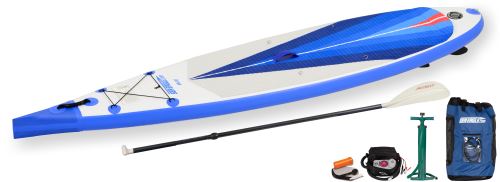
Dimensions: 11’6” x 30” x 6”
Type: Inflatable
The Skinny: The Needlenose is a bit of a well-guarded secret in the paddleboard world, as it’s best obtained straight from Sea Eagle, its manufacturer. Sleek, streamlined, and light, it’s built more for speed than the first two iSUPs we looked at, so it only holds up to 200 lbs. The sharp front (the board’s needle-nosed namesake) helps the Needlenose cut through the water, allowing for a quick and smooth ride. Finally, the 3-year warranty is nice.
One drawback – as we mentioned, the Needlenose is a sleek, streamlined board designed specifically for flat water. It doesn’t do well with too much weight, and it doesn’t do well with overly choppy water. You’ll want to use it on the lake and other calm locales.
Click here to view the Sea Eagle Needlenose SUP on Sea Eagle
Conclusion
As you may have noticed, experienced riders won’t be able to find very many speedy, maneuverable boards for under $1000. Indeed, many boards under $1000 feature generous width and traction features geared towards novices. However, if you’re looking to pick up your first paddleboard and really dive into riding the waves, you needn’t spend more than $1000, as there are plenty of great, comfortable, reasonably priced options out there. If you’re looking for a sleeker, more maneuverable board, check out our article on Inflatable vs. Hard SUP boards – under the hard section, you’ll find some of the best stand up paddleboards of the year, including Outdoor Online’s 2015 Gear of the Year award winner.